
By successfully leveraging factors like schedule flexibility, work-life balance and benefits, organizations can outweigh preferences for compensation and outcompete those that rely on compensation alone for hiring trends and attract candidates.
What we did:
LocumTenens.com and Advisory Board launched a clinician workforce survey to get an updated view into how over 730 physicians and advanced practice providers (APPs) think about employment.
What did we find?
1. Satisfaction does not guarantee retention. This is true for clinicians at all stages of their careers.
2. Compensation is the top priority for clinicians when selecting a job. However, non-pay factors, like schedule flexibility and work-life balance, can and do make up for lower pay.
3. No one employer type emerges as the clear winner for all medical professionals.
What does matter beyond compensation?
While compensation remains the top priority (22.4%), non-compensation factors are close behind. Schedule flexibility (13.3%) and work-life balance (11.5%) were cited as key priorities, along with other non-compensation benefits (8.4%):
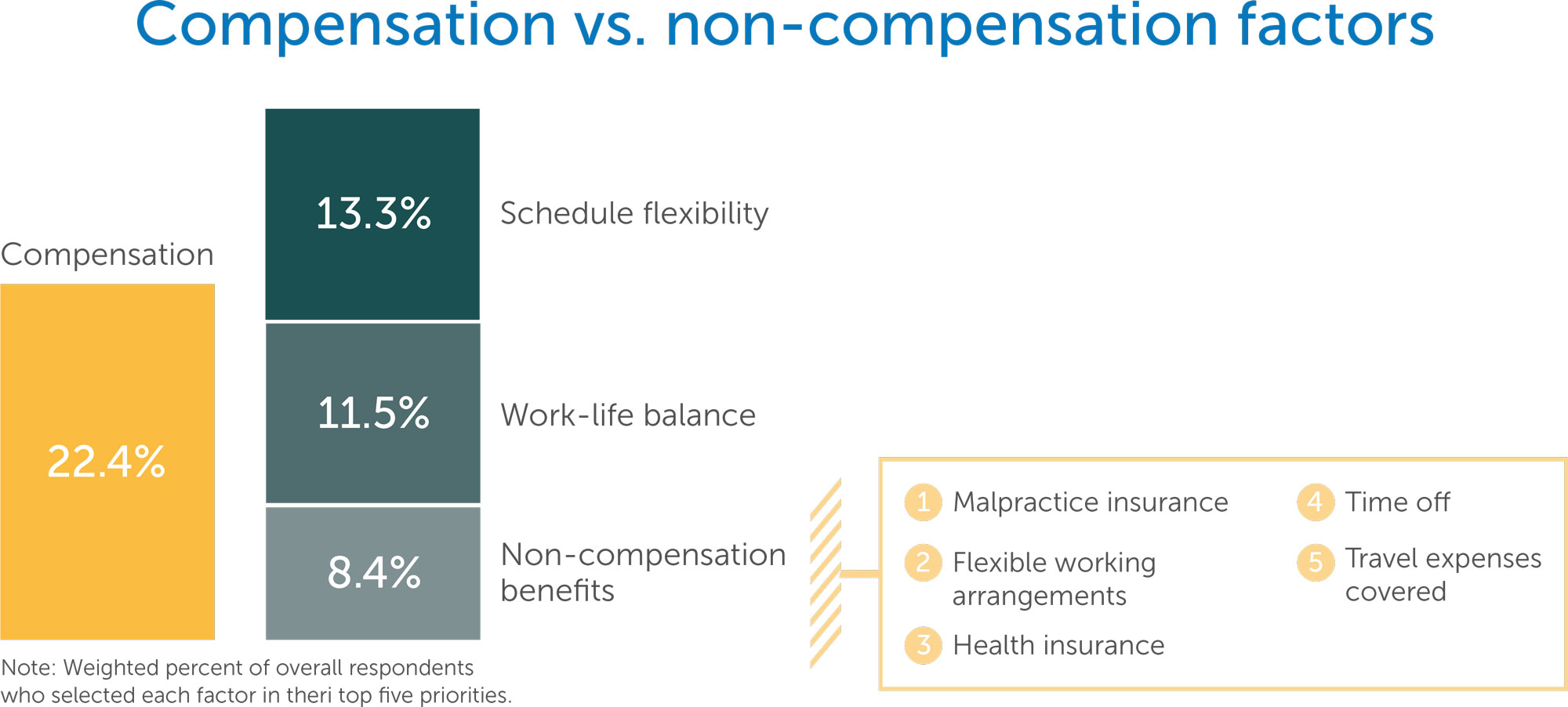
Individually, these factors may not be enough to win over talent. However, this data emphasizes the value and importance clinicians place on a holistic environment that provides supportive working conditions. As it becomes increasingly hard to out-pay competitors, this data reinforces that non-compensation factors can, and do, make the difference.
Clinicians don’t want to work less; they want increased flexibility around when they work:
Market leaders report a growing interest in part-time work, but our survey found that W-2 employed clinicians overwhelmingly prefer a full-time schedule. However, most clinicians, both employed and contracted, prefer a more flexible schedule to a predictable one:


It's about more flexibility around when they work, offering more control in career trends in healthcare.
Work-life balance means a lot.
Clinicians are concerned with time. Four of the top five work-life balance components ranked by clinicians are about time, with the fifth concerning access to flexible scheduling:
“What work-life balance components are most important to you?”
- Adequate time for family commitments
- Flexible scheduling options
- Paid time off
- Coverage when taking time off
- Adequate time for rest and relaxation
Meet the market on compensation. Outperform on schedule flexibility, work-life balance and benefits:
Regardless of age or role, clinicians consistently prioritized the same five factors when selecting a job. While organizations must meet baseline market expectations to compete for talent, a recruitment strategy based on pay is unsustainable. Instead, differentiate yourself concerning the role of physicians in demand for care: schedule flexibility, work-life balance and benefits.
Interested in more valuable knowledge? Click here to see the full report.

About the author
Alison Sawyer
VP of Strategy & Innovation
Alison Sawyer joined LocumTenens.com in 2019, bringing a wide range of experience in the healthcare industry managing large organizational transformations, new product development and process improvement. As the VP of Strategy & Innovation, Alison manages LT’s strategic initiatives and underlying corporate projects, the innovation program, and leads conceptualization and market exploration of potential service offerings. Prior to joining LT, Alison served in roles focused on innovation and business model transformation at Elevance Health (formerly Anthem Blue Cross Blue Shield), Deloitte Consulting and the Advisory Board Company. A self-proclaimed triple tar heel, she holds an undergraduate degree, MBA and MHA from the University of North Carolina at Chapel Hill. Alison resides in Marietta, Ga with her husband Michael and two children, Fitz and Charlotte.